Abstract
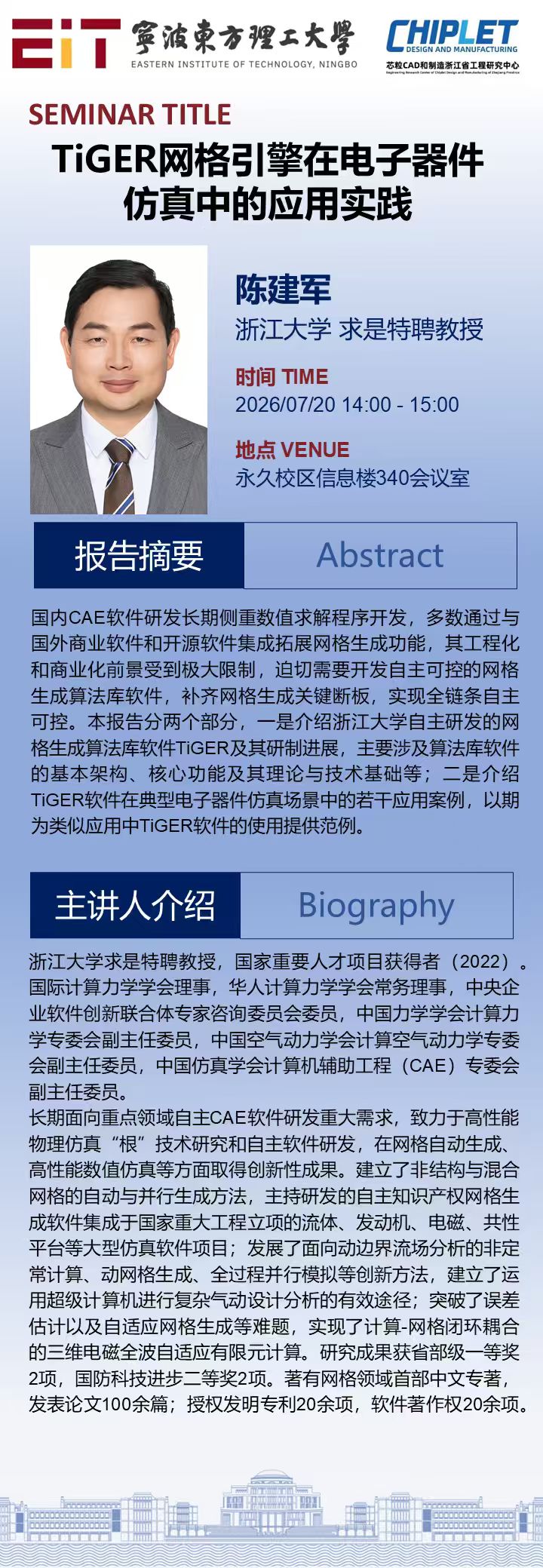
Domestic CAE software research and development has long focused on the development of numerical solvers. Most expand mesh generation functions by integrating with foreign commercial and open-source software, which greatly limits their engineering and commercial prospects. It is urgent to develop self-controllable mesh generation algorithm library software to fill the critical gap in mesh generation and realize full-chain autonomy and controllability. This report is divided into two parts. The first introduces TiGER, a self-developed mesh generation algorithm library software by Zhejiang University, and its research progress, mainly involving the basic architecture, core functions, as well as theoretical and technical foundations of the algorithm library software. The second presents several application cases of TiGER software in typical electronic device simulation scenarios, so as to provide examples for the application of TiGER software in similar scenarios.
Biography
Qiushi Distinguished Professor of Zhejiang University, recipient of a national key talent program (2022). Council Member of the International Association for Computational Mechanics, Standing Director of the Chinese Association for Computational Mechanics, Member of the Expert Advisory Committee of the Central Enterprise Software Innovation Consortium, Vice Chair of the Computational Mechanics Committee of the Chinese Society of Theoretical and Applied Mechanics, Vice Chair of the Computational Aerodynamics Committee of the Chinese Society of Aerodynamics, and Vice Chair of the Computer-Aided Engineering (CAE) Committee of the China Simulation Federation.
Targeting the major demands for independent CAE software development in key fields, he commits to the research of core technologies for high-performance physical simulation and independent software development, and has obtained innovative achievements in automatic mesh generation and high-performance numerical simulation. He established automatic and parallel generation methods for unstructured and hybrid meshes. The self-developed mesh generation software under his leadership has been integrated into large-scale simulation software projects of fluid, engine, electromagnetics and general platforms approved under national major engineering programs. He developed innovative methods including unsteady computation for moving boundary flow field analysis, dynamic mesh generation and full-process parallel simulation, and established effective approaches for complex aerodynamic design and analysis using supercomputers. He has broken through bottlenecks in error estimation and adaptive mesh generation, and realized closed-loop coupled three-dimensional full-wave adaptive finite element electromagnetic computation. His research achievements have won two first prizes at provincial and ministerial levels and two second prizes of the National Defense Science and Technology Progress Award. He is the author of the first Chinese monograph in the mesh field, has published more than 100 papers, and holds over 20 authorized invention patents and more than 20 software copyrights.